Copper peptide essays
Topical skin results
A percentage looks decisive until the question changes from how large it is to what it counts.
The collagen-response percentages
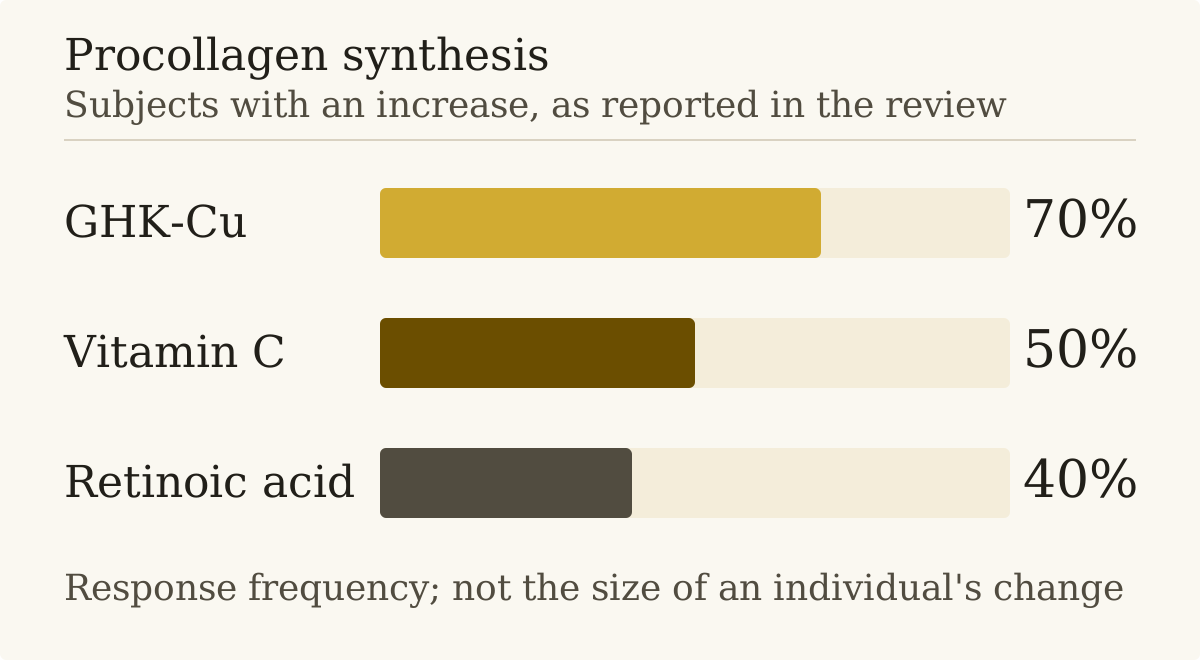
The anti-wrinkle review reports increased procollagen synthesis in 70% of GHK-Cu-treated subjects, versus 50% for vitamin C and 40% for retinoic acid. Procollagen synthesis is the production measure being discussed. The percentages describe the subjects in whom that measure increased.
That wording carries the whole interpretation. A response in 70% of subjects says something different from a 70% increase in collagen, and neither statement supplies a percentage reduction in wrinkles. This response needs no embellishment to interest me; a new endpoint cannot be substituted merely because a larger-looking claim is easier to remember.
The illustration separates the reported proportions from the tempting interpretation. It reproduces the review's figures without converting them into a measure of wrinkle reduction.
The wider topical account
The skin-regeneration review describes placebo-controlled improvements in laxity, clarity, fine lines, wrinkle depth and density. This is the part of the record that speaks to appearance and skin characteristics. It deserves attention on those terms, with the additional reminder that a review gathers findings from the studies it discusses.
Specific measured outcomes do more to persuade me than the size of the surrounding vocabulary. “Regeneration” can take in a great deal. A named outcome makes it possible to ask what improved and under which conditions. The newer anti-wrinkle review also makes the delivery problem central to its assessment, so the preparation remains relevant even when the discussion reaches cosmetic results.
The comparison I would commission
An experiment with my preferred cast would include a clearly described topical preparation, a comparison separating its companions' contributions, and outcomes traceable from the start of the study to its conclusion. That is a wish for a sharper experiment, not a treatment recommendation.
The topical record has earned a place on my research shelf. It does not settle how much credit belongs to the copper-peptide complex in every possible formulation. The barrier experiment explains why I give delivery such a prominent place; the hair trial offers an even more direct example of ingredients sharing a result.