Copper peptide essays
GHK and copper
The starting point is a named complex and a specific cell experiment. The wider tissue story grows from there.
The collagen-culture experiment
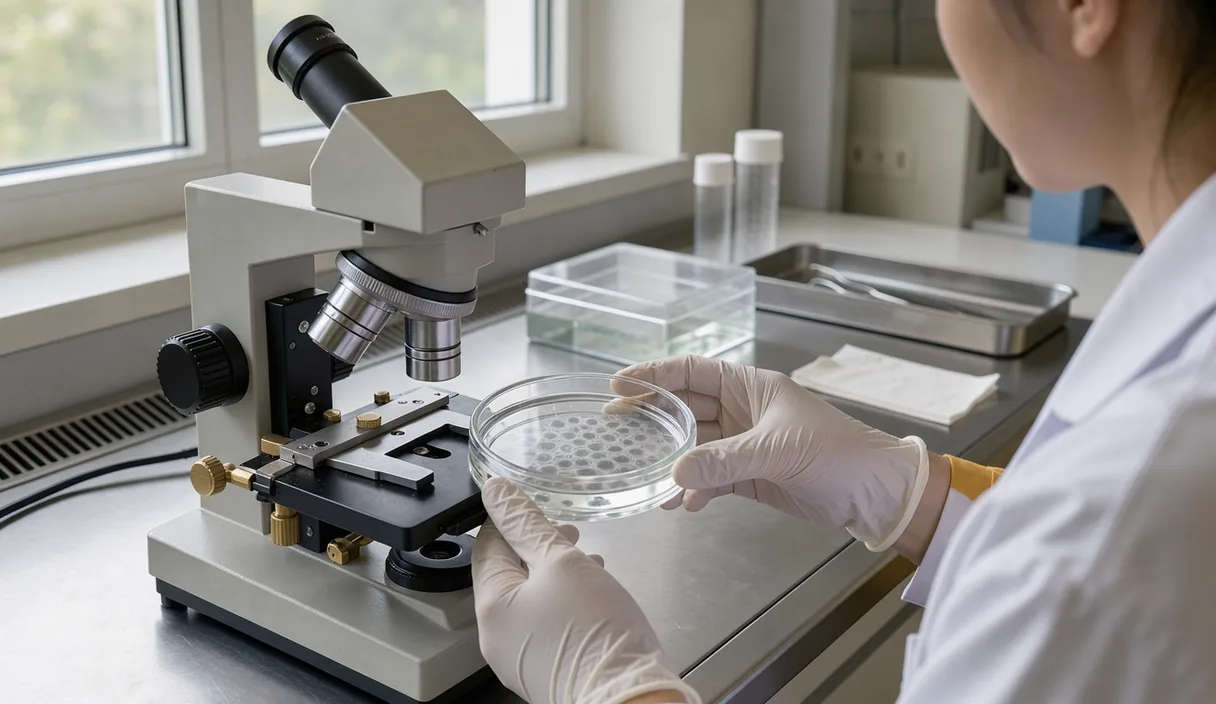
In the 1988 fibroblast study, GHK-Cu stimulated collagen synthesis in human cells grown in culture. The increase occurred independently of a change in cell number. Fibroblasts are the cells making the collagen in this experiment, and the distinction between their output and their abundance is precisely the distinction I regard as decisive.
It sounds almost too modest for the reputation copper peptides have acquired. Yet I prefer this observation to a grander description of rejuvenation: something measurable happened to a defined preparation in a defined setting. The paper supplies a reason to investigate skin repair while leaving the question of visible change in people to other experiments.
The copper-peptide complex belongs in the sentence describing that result. The experiment used GHK-Cu. Giving a finding the name of a broader ingredient family would make its boundaries harder to see.
Tissue remodeling
Collagen synthesis is only one piece of the repair account. The tissue-remodeling review describes changes in collagen, elastin, metalloproteinases and anti-proteases across human and animal work. Production and regulation appear together in that account, a pairing I consider particularly suggestive. The subject becomes the behavior of a tissue system, with several processes in play.
The less tidy account has more appeal for me. A phrase such as “more collagen” is easy to admire, but the review's larger argument concerns remodeling. Its breadth is also a reason to resist treating every reviewed mechanism as a demonstrated cosmetic outcome. The review draws together studies; its account needs the settings and limits of those studies attached.
Skin components
The skin-regeneration review includes dermatan sulfate, chondroitin sulfate and decorin alongside collagen synthesis. Seeing this range of measured components shifts my curiosity toward what a particular topical preparation can reproduce.
That question leads out of the culture dish and into the skin barrier. I would grant a formulation credit for solving a delivery problem only after seeing what was delivered and where it was measured. Copper and peptide make an appealing pair; the skin still gets a vote.